
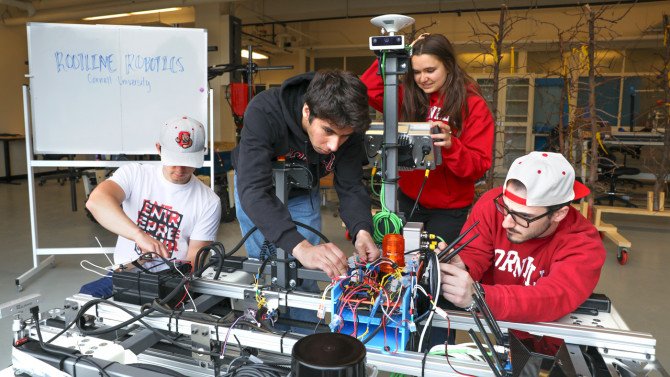
Andrew James (from left), Neil Morrison, Natalia Kurz, and Michael Neiss work on their award-winning weed-killing robot ahead of The Farm Robotics Challenge.
By Holly Hartigan
A team of undergraduates from Cornell University triumphed over 95 competing teams at The Farm Robotics Challenge, securing the grand prize with their innovative creation: an autonomous robot designed to eradicate weeds using electricity. This groundbreaking technology targets weeds in vineyards and orchards, facilitating effective pest control without relying on human operators or traditional herbicides.
Led by Andrew James, an agricultural sciences major at the College of Agriculture and Life Sciences (CALS), the team conducted in-depth research into existing electrical weeding technologies. Over four rigorous months, they developed a low-energy system and built a working prototype capable of traversing fields, zapping weeds with minimal energy consumption, thus preserving crops and reducing labor costs.
Natalia Kurz, a fellow CALS student focused on biological engineering, noted the intense commitment required for the project. “There were moments when we feared our efforts might be in vain,” she reflected. “But the hard work truly paid off.”
The $50,000 prize will help James and his teammates establish Rootline Robotics, a company dedicated to further developing their revolutionary robot. The agricultural technology firm Reservoir, which sponsored the competition, has offered to host the startup at its incubator in Sonoma, California, providing invaluable resources and support.
James expressed his long-standing ambition to launch a startup in ag-robotics. “Winning this competition and witnessing the collaborative spirit from various industry stakeholders has motivated us to pursue this venture vigorously,” he stated.
Addressing the Weeds Problem
Weeds present a significant obstacle for growers in orchards and vineyards, siphoning water and nutrients, particularly in the crucial spring months. According to Steve Selin, owner of South Hill Cider in Ithaca, weed pressure can be relentless. “Without the ability to weed-whack or mulch extensively, the grasses encroach on the trees, contributing to stress that could cause the trees to drop their fruit,” he explained.
Currently, organic farmers rely on labor-intensive methods such as string trimming and mowing to manage weed growth. Existing electric weeders are typically cumbersome and pricey, averaging around $150,000 and requiring an operator. James noted that their innovative robot offers a cost-effective and energy-efficient alternative.
Selin, who provided feedback during the robot’s development, is eager to test the technology. “If we can manage to suppress weeds effectively in May and June, it would alleviate competition with the trees for the rest of the year,” he said. “This would also allow weeds to return, providing ecological benefits like soil shading, which fosters a healthier microbial ecosystem.”
The Interdisciplinary Nature of Robotics
“Robotics encompasses diverse systems,” Kurz remarked. “Its interdisciplinary nature is key to our approach.”
The Rootline team is set to refine its technology further and validate its effectiveness with farmers before launching it commercially, all while Kurz and her teammate Michael Neiss complete their degrees. Neiss highlighted the synergy within the team: “Having multiple perspectives in a room leads to solutions that are both feasible and effective.”