
University of Leeds and UC San Diego Win Best Paper Award in Soft Robotics
Researchers at the University of Leeds, in collaboration with the University of California, San Diego, received the Best Paper Award at RoboSoft, the premier international conference dedicated to soft robotics research. This area of study is increasingly significant in medical applications, where soft robots can safely interact with delicate tissues and complex anatomy.
The award-winning research introduces a groundbreaking 1.8 mm soft growing robot capable of being steered by magnetic fields. It can sense its shape in real-time and functions without requiring internal pressure. These innovations hold promise for enhancing patient outcomes during minimally invasive medical procedures.
We spoke with lead author Benjamin Calmé to gain insights into the team’s remarkable work.
Background on the Researcher
Benjamin Calmé’s journey into the world of robotics is quite unique. Originally pursuing a medical degree in France, he realized his passion lay more in research than in everyday clinical practice. In France, aspiring researchers in medicine must also obtain an engineering degree, which led him to pivot toward engineering and subsequently, robotics. His experience in robotics labs in Paris and Strasbourg focused on medical applications, such as needle insertion using MRI scanners and technologies aimed at helping runners minimize injury risks.
Calmé’s diverse background makes him particularly valuable in medical robotics, serving as a bridge between surgeons and engineers. His role involves conveying surgeons’ clinical needs to engineers, thereby ensuring solutions align with practical medical requirements. Additionally, he supports the transition of technologies to pre-clinical testing by developing study protocols and aiding clinicians in understanding the performance of new platforms compared to traditional tools.
Understanding “Growing Robots”
For those unfamiliar with soft robotics, a “growing robot” operates more like a plant than a traditional mechanical robot. Instead of advancing by pushing or dragging its entire body, this type of robot extends from its tip, effectively growing into the space ahead. Often referred to as “vine robots,” their design is inspired by climbing plants, allowing them to navigate around obstacles by deforming and adapting to their environment.
Addressing Medical Challenges
The research focuses on diminishing friction, a central challenge in many medical procedures. Conventional flexible tools can rub against tissues during insertion and withdrawal, leading to discomfort and inflammation for patients. The growing robot minimizes this friction by allowing the sections already inside the body to remain stationary while the new material extends from the tip. This capability can alleviate patient discomfort and enable procedures in delicate areas, such as the brain, where precision is paramount.
Significance of Pressure-Free Growth
The paper highlights the importance of a pressure-free growth mechanism. This advancement not only enhances safety but also contributes to better control. Traditional growing robots depend on internal air pressure, which poses risks in fluid-filled environments like blood vessels. By eliminating the need for internal pressure, these risks are mitigated. Furthermore, the current design allows for simultaneous growth and steering, improving system efficiency.
Innovative Design Features
A notable aspect of the team’s approach is the integration of shape control and sensing into a miniature structure. The prototype boasts an outer diameter of just 1.8 mm. While many previous designs employed separate actuators or sensors throughout the robot, which complicated miniaturization, this innovation embeds magnetic functionality directly into the silicone material, allowing for precise control and real-time shape estimation.
Real-World Applications and Future Steps
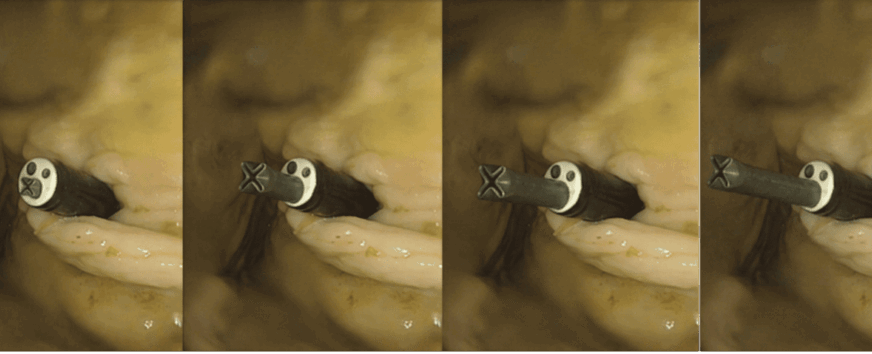
The research demonstrates successful retroflexion and biopsy in an ex vivo stomach model, showcasing the robot’s capability to perform endoscopic maneuvers in a medically relevant context. These milestones indicate that the pressure-free growing robot can undertake vital clinical tasks, paving the way for further development in neural and spinal applications.
The path to clinical use remains meticulous, as rigorous regulation is necessary to ensure patient safety. Current efforts focus on achieving robust pre-clinical performance, assessing safety and biocompatibility, before moving toward clinical adoption. Calmé envisions a future where this soft growing robot can provide more precise, less invasive tools for surgeons, thereby transforming medical procedures.
The research paper, “Pressure-free Magnetic Soft Growing Robot with Real-Time Shape Control and Sensing for Biome Sampling,” is included in the proceedings of the 2026 IEEE 9th International Conference on Soft Robotics (RoboSoft).