
Engineers Develop Innovative Aerial-Aquatic Robot Inspired by Nature
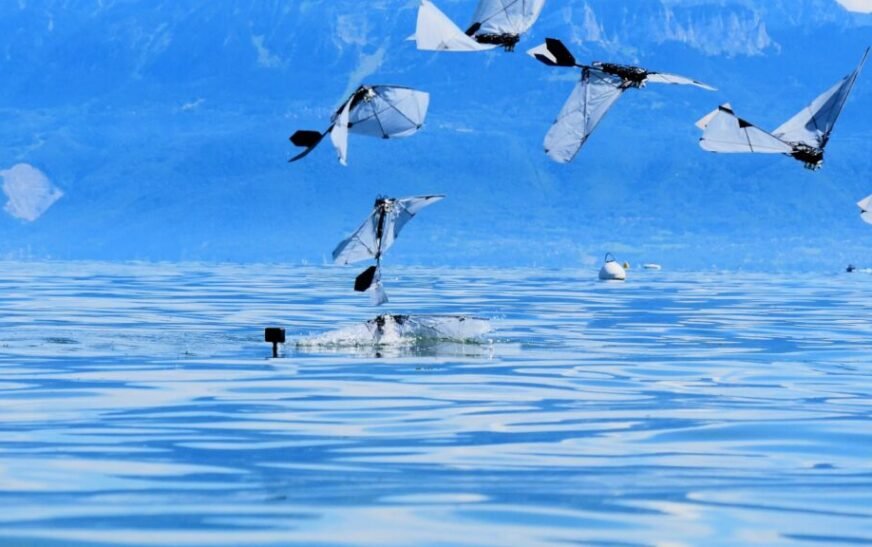
Loons, gulls, puffins, and petrels are among the approximately 100 bird species that possess the unique ability to both fly and swim. These diving birds adeptly plunge into the water to hunt for prey and then take to the air with grace. Inspired by these natural aviators, engineers from EPFL and MIT have created a groundbreaking robot capable of swimming underwater and soaring into the air, reminiscent of these diving birds.
Introducing the Flapping-Wing Aerial-Aquatic Vehicle
The “Flapping-Wing Aerial-Aquatic Vehicle” (FAAV) weighs under 300 grams and is intended to aid researchers in studying the mechanical principles that allow diving birds to transition between air and water, which have contrasting physical properties. This robot features a central fuselage, two flexible flapping wings, and a steerable tail. Researchers have designed interchangeable wings and tails of various sizes to optimize performance. Experiments conducted in both a controlled water tank and a natural lake enabled engineers to determine effective combinations of wing size, flapping frequency, and tail angle, facilitating a smooth transition from swimming to airborne flight.
Applications for Oceanography and Marine Biology
The team published their findings in Science, highlighting how these insights could advance the understanding of flying mechanics in aquatic birds. The research may pave the way for a new generation of aerial-aquatic drones, equipped to sample regions that pose risks for traditional vessels. The team envisions deploying these winged robots to access areas like icebergs, port facilities, or even pods of whales, thereby collecting valuable data at a significantly reduced cost compared to existing methods.
Insights from Flight Mechanics
Raphael Zufferey, lead author and former researcher at EPFL, now an assistant professor at MIT, elaborated on the vision for this innovative technology. Zufferey began this project while working in EPFL’s Laboratory of Intelligent Systems and Biorobotics Lab, under the guidance of Dario Floreano and Auke Ijspeert. Following its completion at MIT, where Zufferey now leads the AURA Lab—dedicated to engineering bioinspired aerial and aquatic vehicles—this study features contributions from collaborators at Northwest Indian College in the USA.
Engineering the Wings
The design employs wings crafted from thin membranes coated with hydrophobic nanoparticles to repel water efficiently. Inside the fuselage, a battery powers a waterproof electric motor, which drives a crankshaft to facilitate wing movement at predetermined frequencies. The motorized tail adjusts its angle to assist in either ascent or descent. Initial tests in a small EPFL water tank, later expanded to Lake Geneva, reinforced the importance of wing size and flexibility. The robot demonstrated swimming speeds of nearly one meter per second and flying capabilities of approximately six meters per second, both at around five flaps per second, aligning closely with the performance metrics of real diving birds.
A New Approach to Aerial Movement
Interestingly, the robot’s architecture allows it to successfully swim and launch itself into the air without utilizing feet, a feature typically essential for many diving birds. Zufferey pointed out the significance of this finding, stating that past robotic designs have struggled with takeoff from water. The robot’s ability to achieve flight without this traditional mechanism represents a significant evolution in robotic design.
Future Developments and Research Directions
Looking ahead, the research team plans to refine the design of the wings, enabling more dynamic movements beyond simple up-and-down flapping. They intend to evaluate the robot’s performance in turbulent conditions, including navigating choppy waters and enduring wind gusts. Ultimately, the aspiration is to deploy this innovative vehicle to tackle pressing questions within ocean science.
Research Reference
Leaping out of the water: Aerial-aquatic locomotion with flapping wings, Raphael Zufferey, Simon L. Jeger, Moritz Hüsser, Fernando Ruiz, Anthony Lapsansky, Auke Ijspeert, Dario Floreano, Science (2026).