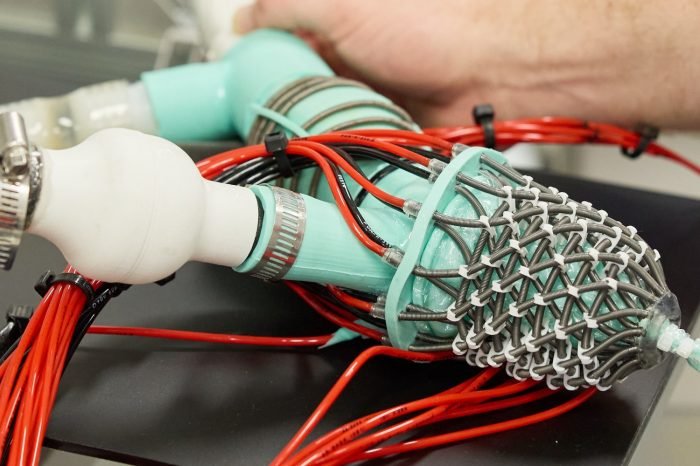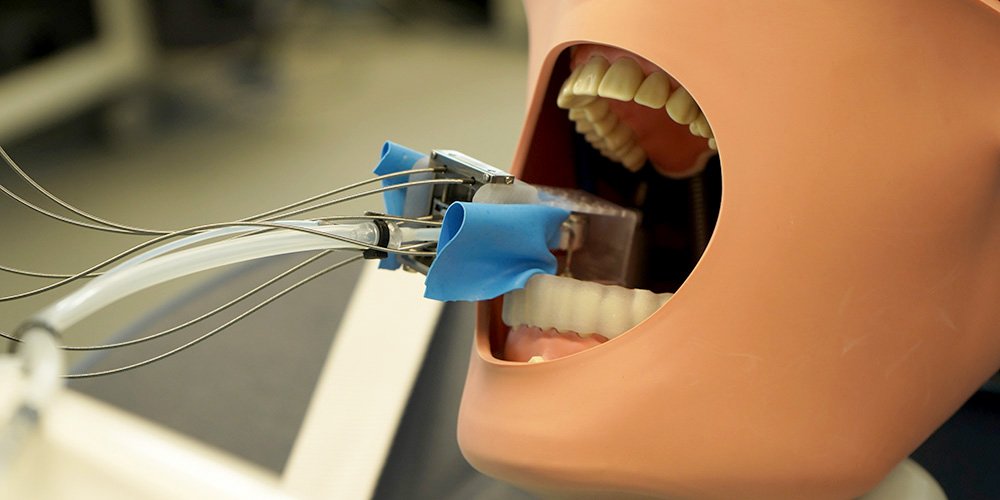

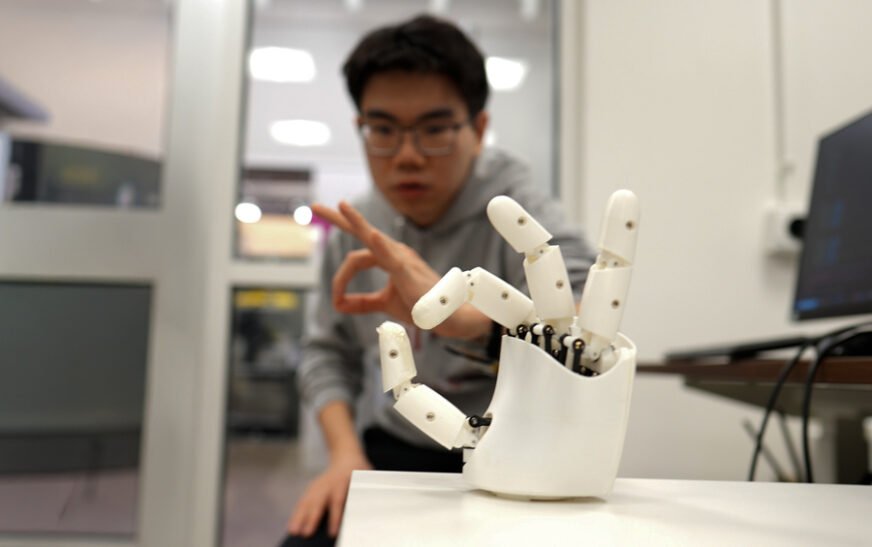
Graduate student Dian Li working with a robotic hand. Credit: Melanie Gonick.
Advancements in Hand Tracking Technologies
The next time you find yourself scrolling through your phone, consider the intricate coordination at play: the action relies on 34 muscles, 27 joints, and over 100 tendons and ligaments within your hand. This remarkable dexterity has presented a formidable challenge in robotics and virtual reality for years. However, engineers at MIT have made significant strides by developing an innovative ultrasound wristband that can accurately track hand movements in real-time.
Real-Time Tracking with Advanced Technology
This wristband captures ultrasound images of the wrist’s muscular and tendinous structures as the hand maneuvers. Complemented by a sophisticated artificial intelligence algorithm, the device translates these images into the real-time positions of each finger and the palm. Researchers can train the wristband to understand specific hand motions, enabling seamless communication with a robot or a virtual environment.
Wireless Control of Robotic Hands
In live demonstrations, individuals wearing the wristband have been able to wirelessly control robotic hands, mimicking gestures such as pointing or playing the piano. This wireless marionette interaction allows users to manipulate robots to perform simple tasks, like shooting a small basketball or resizing virtual objects on a screen. The potential applications are vast, including gaming and various design applications.
Building a Comprehensive Dataset
To enhance the technology’s effectiveness, the research team is collecting hand motion data from a diverse group of users with different sizes and gestures. The aim is to build a comprehensive dataset that could be leveraged to train humanoid robots for dexterous tasks—potentially even surgical procedures. The ultrasound wristband offers exciting possibilities for grasping and interacting with objects in both real-world and virtual settings.
Comparative Approaches to Hand Dexterity
Existing methods for mimicking human hand dexterity often rely on cameras to track movements or gloves equipped with sensors. While these can be effective, they are cumbersome and susceptible to visual obstructions or physical restrictions. Alternative methods capture muscle signals, but these can be noisy and fail to detect subtle nuances in finger movements. Zhao’s team thus explored ultrasound imaging as a more effective alternative.
Innovative Wearable Design
The wristband incorporates a miniaturized ultrasound sticker, akin to medical transducers, allowing continuous imaging of wrist muscles and tendons. This design offers an advantage: by associating ultrasound images with hand positions, the researchers can precisely map the 22 degrees of freedom in finger movement. This capability was established through rigorous tests involving multiple cameras to confirm positions against ultrasound imagery.
Implementing Artificial Intelligence for Accuracy
To automate the translation of image data into actionable commands, the team employed an AI algorithm trained to correlate ultrasound patterns with specific hand gestures. This AI successfully identified movements during tests conducted with various volunteers performing gestures and holding a range of objects. Results showed the wristband maintained an impressive accuracy in tracking hand positions.
In practical applications, the wristband has demonstrated its versatility by wirelessly connecting to a simple computer program that allows users to pinch or grasp objects on a screen, translating their motions fluidly. Users have successfully controlled robotic hands to simulate piano playing or engage in interactive games, showcasing the potential for further advancements in virtual reality and robotic dexterity.
Zhao and his team are committed to refining the technology by miniaturizing the wristband’s components and expanding the dataset to include a broader variety of hand movements. Their vision is to create a universally applicable wristband that can empower users to manipulate virtual objects or humanoid robots with unprecedented precision.
This research has been supported by various institutions including MIT, the National Institutes of Health, and the National Science Foundation, underscoring its contributions to the future of AI-driven automation technologies.