
Revolutionizing Robot Learning with Interactive Simulators
Training a robot to perform simple tasks, such as pushing an object on a table, typically involves extensive data collection and real-world trials. Traditionally, learning protocols require numerous expert demonstrations on physical robots, followed by imitation learning training and repeated evaluations. These processes are not only time-consuming and costly but also prone to challenges like hardware failures, environmental changes, and the need for increased lab hours every time a new task is introduced.
Can Simulation Replace Real-World Training?
A logical consideration is whether a simulator can alleviate some of the burdens associated with real-robot training. While classical physics-based simulators offer robust capabilities, creating one for a new task is often a labor-intensive endeavor that requires meticulous modeling of geometries, contacts, and other physical interactions. Furthermore, the resulting simulators frequently fail to accurately reflect the real world, making it difficult for policies developed in simulation to translate effectively to actual robots.
Introducing the Interactive World Simulator
Our research presents a novel approach: the Interactive World Simulator. This learned, action-conditioned video prediction model generates future frames based solely on the current image and a sequence of robot actions, without relying on a physics engine. Capable of allowing control through a teleoperation device, the simulator can maintain a stable and coherent predicted video at 15 frames per second for over ten minutes using a single RTX 4090 GPU.
Unlocking Efficiency in Robot Learning
The primary innovation of our simulator is its potential to address two significant bottlenecks in robot learning: the affordability of data generation for training and the scalability and reproducibility of policy evaluation. By collecting demonstrations within the simulator, the cost and time associated with real-world data collection can be dramatically reduced. Moreover, policy evaluations can be conducted under identical conditions, eliminating the inconsistencies that often plague real-world testing.
Capabilities of the World Simulator
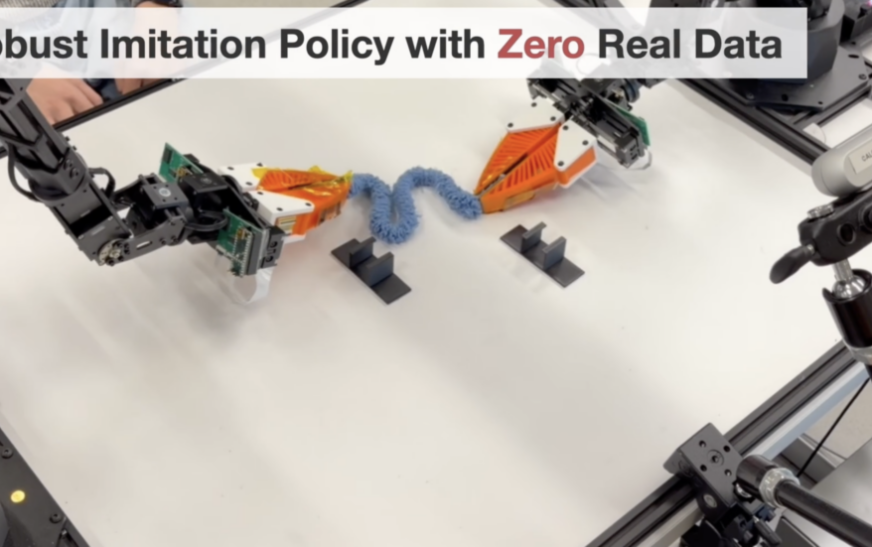
We trained the Interactive World Simulator on four distinct manipulation tasks: T pushing (rigid-body contact), rope routing (deformable-rigid interactions), mug grasping (fine-grained gripper dynamics), and pile sweeping (managing groups of objects). Notably, these behaviors emerged solely from interaction data, without any physics assumptions hard-coded into the system. For example, in rope routing, the simulator accurately differentiates between a rope being inserted into a clip and merely swinging past it, maintaining an unbiased approach based on the actions performed.
Unique Aspects of Our Simulator
Our approach exhibits several advantages over existing robot simulation methods. Traditional physics simulations often necessitate detailed modeling and can suffer from a significant sim-to-real gap. Although newer data-driven models provide alternatives, many are not tailored for real-time interactions or are unstable during long-duration rollouts. In contrast, our Interactive World Simulator is purpose-built for action conditioning, yielding accurate pixel-level predictions while enabling extensive interactive sessions.
Applications: From Data Generation to Policy Evaluation
One significant application of our simulator is the ability to generate scalable training data. By conducting demonstration training entirely within the world model and evaluating the results on physical robots, we found that policies trained exclusively on simulated data could perform comparably to those trained on real-world demonstrations. This emphasizes the simulator’s capability to produce high-quality data.
Additionally, it facilitates effective policy evaluation. Traditional evaluation processes can be cumbersome, necessitating scene resets and policy re-runs under closely matched conditions. Our simulator allows for reproducible policy evaluations by rolling out multiple strategies within the same environment, demonstrating strong correlations between simulator and real-world performance during testing.
As we look ahead, the potential of action-conditioned video prediction for advancing robotics is significant. By optimizing stability and computational efficiency, the Interactive World Simulator serves as a practical tool for both training and evaluation. Future research will focus on enhancing the simulator’s framework to accommodate more complex tasks and diverse environments, further exploring the scalability of performance based on interaction data and computational resources.