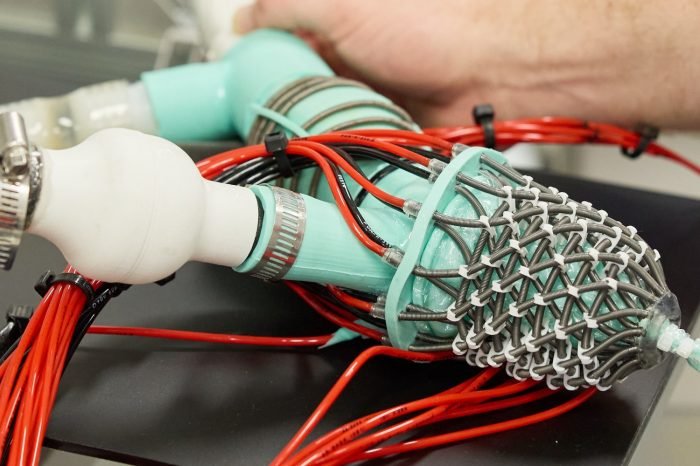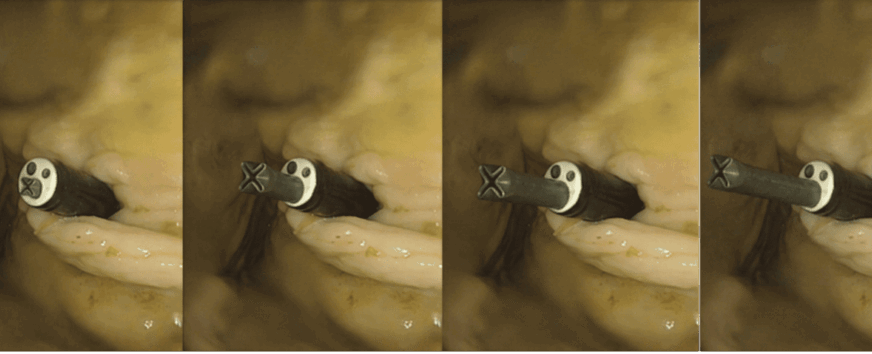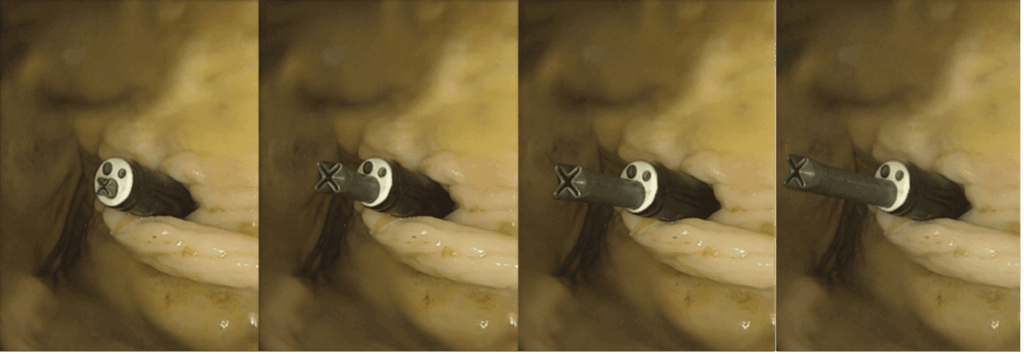

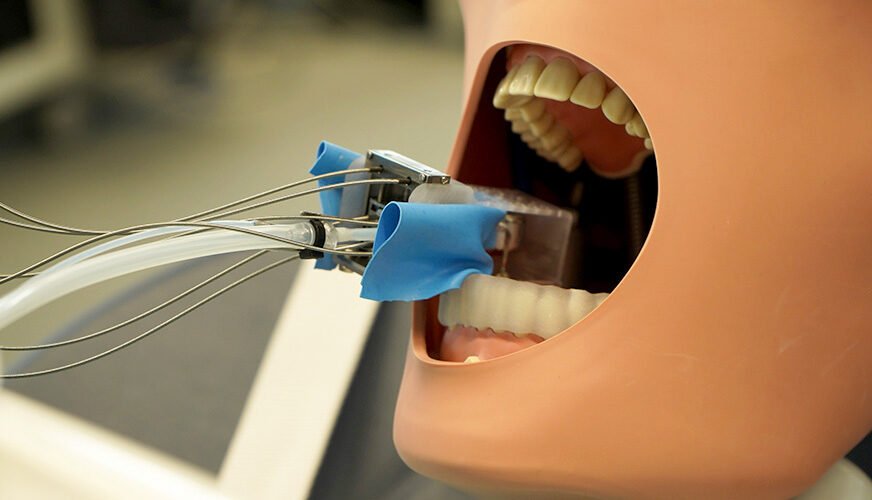
A miniature robot developed at the University of Basel could assist in preparing teeth for crowns. Photo: University of Basel, Catherine Weyer.
By Angelika Jacobs
A routine visit to the dentist can sometimes unveil unwelcome news: a large cavity necessitating a crown. Traditionally, this treatment involves several appointments. Initially, the dentist will remove decay, fill the cavity, and prepare the tooth for the crown. After taking an impression, they fit a temporary crown until the permanent one is ready for a subsequent visit.
However, this process may undergo significant transformation due to a small dental robot created by researchers from the Department of Biomedical Engineering at the University of Basel, in collaboration with colleagues from the University of Zurich.
The prototype, named MIR for “Miniature Intraoral Robot,” measures a compact 43 by 26 by 28 millimeters, roughly the size of a wine cork. Its motors and control system are external, linked to the robot via flexible drive shafts, cables, and tubes. Dr. Yukiko Tomooka, the primary author of a study published in IEEE Transactions on Medical Robotics and Bionics, emphasizes that the design ensures the robot can comfortably fit within a patient’s mouth.
Reducing Dental Appointments
MIR is engineered to prepare teeth with precision according to a digital treatment plan. During the initial appointment, after a dental scan is performed, dentists can use this information to instruct the robot on the necessary tooth material removal, thus streamlining the process by allowing the crown to be ordered immediately rather than waiting for a second appointment.
The researchers conducted tests of the dental robot on synthetic resin tooth models and materials mimicking tooth enamel’s hardness. The preparation process consists of two stages: initially using a wide drill to reduce the tooth’s surface from above, followed by a longer, thinner drill that refines the sides of the tooth.
Precision and Force Management
The accuracy of this dental robot is noteworthy. In tests, it achieved a positional error of less than 0.2 millimeters, a figure expected to decrease further with the integration of additional sensors. Additionally, the forces generated during drilling were found to be under five newtons, equivalent to the weight of a half-liter water bottle. The research team is also examining the noise levels produced by the robot to evaluate its practicality in dental settings.
Future Developments: Integration of Sensors and Cameras
Before MIR can be implemented in dental clinics, further advancements are required. The next phase involves incorporating sensors and a camera to enable the robot to monitor its own position and treatment progress. Professor Georg Rauter, the research team leader, explains that even after a power interruption, MIR would maintain an awareness of its location and the next steps in treatment based on sensor feedback—all while preserving its compact size.
Collaboration and Funding
This dental robot was developed as part of an Innosuisse-funded initiative in collaboration with the Center for Dentistry at the University of Zurich, Basel-based Camlog Biotechnologies GmbH, and the University of Bern. The team collaborates closely with practicing physicians and dentists to advance robotic applications in medicine.
Read the Full Research
Miniature Intraoral Robot (MIR) for Minimally Invasive Tooth Preparation, Yukiko Tomooka et al., IEEE Transactions on Medical Robotics and Bionics (2026).