
Image credit: HIMS / Nature Synthesis.
Advancement in Autonomous Laboratory Systems
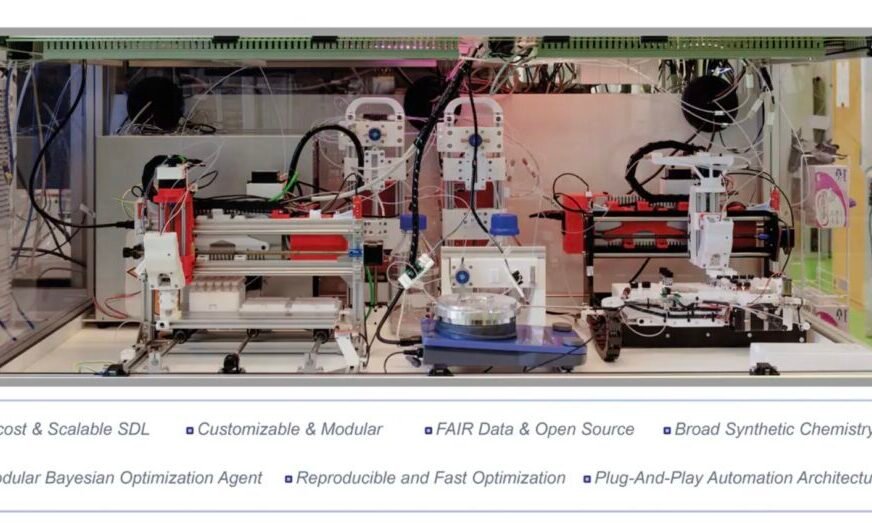
Researchers from the University of Amsterdam’s Van ’t Hoff Institute for Molecular Sciences, led by Professor Timothy Noël, have made significant strides in autonomous laboratory systems with their latest paper published in Nature Synthesis. The study introduces RoboChem Flex, a versatile, modular system designed for synthesis optimization that is accessible to laboratories regardless of their size. The paper outlines comprehensive instructions for building this innovative system.
Professor Noël emphasizes that this updated version of the RoboChem concept aims to democratize access to advanced AI-driven synthesis systems, which have traditionally been prohibitively expensive, limiting their use to well-funded institutions. “Such exclusivity stifles scientific progress,” he states. With RoboChem Flex, he aims to equip researchers at all levels with cost-effective tools that enhance research capabilities and foster innovation.
Enhanced Versatility at a Reduced Cost
The original RoboChem system, showcased in the journal Science in early 2024, was an autonomous flow chemistry system linked to a benchtop NMR system, managed by an integrated machine learning unit. This groundbreaking technology demonstrated its efficacy in expediting the discovery of pharmaceutical molecules, autonomously optimizing the synthesis of ten to twenty molecules—tasks that would take a PhD student several months to complete.
Although the RoboChem system’s capabilities were impressive, its hefty price tag of over $50,000, excluding the expensive NMR equipment, posed a challenge. This prompted Noël and his team to focus on reducing costs while increasing the system’s versatility.
The result is RoboChem Flex, presented in Nature Synthesis. With a projected price of around $5,000, this system supports a broad range of applications, from photocatalysis to biocatalysis. Noël claims success, noting that other affordable automated systems tend to focus on limited problems, thereby sacrificing research potential. In contrast, RoboChem Flex has been tested in six rigorous case studies across diverse chemistry fields, showcasing its adaptability to various experimental challenges.
Advanced Design Using 3D-Printed Components
To maintain affordability and flexibility, RoboChem Flex leverages readily available components and 3D-printed alternatives. This approach not only curtails costs but also facilitates quick customization and iterative enhancements. The communication between the hardware components is streamlined through the OmniPlatypus package, developed in-house by Noël’s research group and made available as open-source. This enables a plug-and-play architecture, requiring minimal coding from users.
On the software side, RoboChem Flex integrates a highly modular Bayesian Optimization (BO) agent tailored to refine the AI-driven synthesis workflow for specific experimental objectives. The platform also accommodates a variety of inline analytical instruments, such as NMR, UHPLC-MS, and Raman spectroscopy, allowing for fully autonomous operation 24/7.
Human-in-the-Loop Approach for Enhanced Accessibility
However, integrating inline analytics can lead to significant costs that often exceed the $5,000 price of the system itself. To counter this, Noël’s team has also designed a cost-effective, 3D-printed liquid sampling unit. “This module facilitates the collection of reaction samples,” Noël explains, “which can then be analyzed using analytical tools frequently shared among multiple research groups.” This human-in-the-loop strategy provides laboratories an affordable entry point, leveling the playing field and enabling innovation across various research environments.
Real-World Applications: Case Studies
- Optimization of pyrrole trifluoromethylation using adaptive weighted exploration and NMR analysis.
- Deoxygenative C–H functionalization via hypervolume optimization using HPLC analysis.
- Noisy hypervolume optimization of photocatalytic isotope labeling using Raman Spectroscopy.
- Selective enzymatic reduction of diketone using HITL and dual acquisition batching.
- Optimization of Buchwald-Hartwig aminations via transfer learning and ligand featureization.
- Multi-objective optimization of an enantioselective photocatalytic [2+2] cycloaddition using chiral HPLC.
All the code utilized for RoboChem Flex is openly accessible on GitHub. This includes machine learning and optimization scripts, graphical user interface software, device firmware, as well as 3D printing design files and schematics for hardware.
Access Full Research Findings
For further details, the complete study can be read at Nature Synthesis, authored by Simone Pilon, Elia Savino, Oliver M. Bayley, and others.