

In the realm of online shopping, product images are often the first touchpoint for customers. However, e-commerce sellers typically require more than just a single image of a product; they often need promotional banners, social media graphics, and branded visuals to complement various sales initiatives.
For small businesses and independent sellers lacking dedicated design teams, creating these visual assets manually can be a time-consuming endeavor. Recraft on Pollo AI presents a solution that enables sellers to produce compelling design-focused images and commercial graphics through artificial intelligence, streamlining the process of transforming product concepts into effective marketing materials.
The Necessity of AI Tools for Accelerated Product Design in E-Commerce
The creation of product visuals often encompasses photography, editing, layout design, and strategic branding decisions. While larger corporations may employ dedicated designers, smaller sellers usually find themselves needing to generate content quickly while juggling limited resources.
AI design tools can significantly reduce the time spent on repetitive design tasks. Rather than beginning each graphic from scratch, sellers can articulate their ideas, generate multiple concepts, and tailor designs according to their product style and marketing objectives.
For instance, an online retailer may require unique visuals for product pages, advertisements, email campaigns, and social media platforms. The incorporation of AI technology simplifies the process of creating variations while ensuring a cohesive overall aesthetic.
This is where Recraft on Pollo AI proves invaluable. By merging AI image generation capabilities with essential design tools, it empowers sellers to create professional-grade visuals without the need for advanced design expertise.
An Overview of Recraft on Pollo AI and Its Benefits for Product Graphics
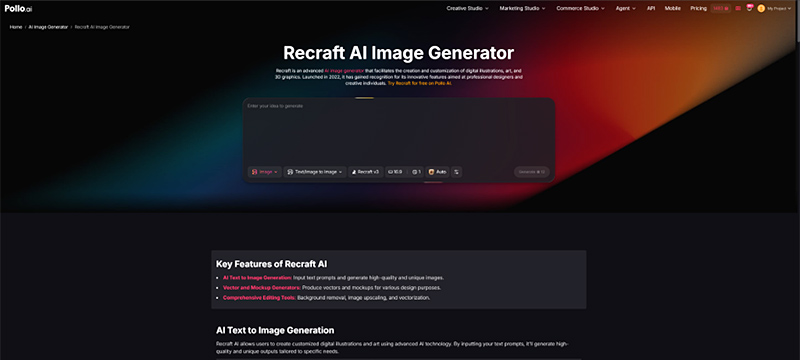
Recraft is an AI-powered design tool tailored for the creation of images, illustrations, vector graphics, and a variety of visual assets. It provides users with enhanced control over design style and consistency, making it an ideal choice for product graphics, branding materials, and marketing content.
By accessing Recraft’s functionalities within the Pollo AI platform, users can leverage its image generation capabilities alongside other innovative AI creation tools available in the Pollo ecosystem. This integration enables e-commerce sellers to navigate different phases of the design process—from crafting product images and promotional graphics to developing branded visuals.
The extensive features offered, including image generation, vector creation, editing, background removal, and image upscaling, equip sellers to create new designs and enhance existing assets effectively. When compared to using Recraft standalone, the Pollo AI platform provides a more comprehensive content creation environment that accommodates the diverse needs of sellers and marketers who require not only images but also advertisements, videos, and social media content.
By consolidating multiple AI resources, Pollo AI emerges as a practical option for small businesses, independent sellers, marketing teams, and content creators aiming to produce various types of visual assets without the hassle of managing multiple platforms.
Steps to Create E-Commerce Product Graphics Using Recraft on Pollo AI
An effective product graphic must be more than visually appealing; it should effectively showcase the product, align with brand style, and be suited for the intended publication platform. Recraft on Pollo AI assists sellers in producing various types of visuals, but the quality of the output hinges on how well the design process is organized. When paired with the Pollo AI image generator, it allows users greater flexibility in exploring different visual styles tailored to various e-commerce needs.
Step 1. Select the Appropriate Product Visual Style
Before initiating the image generation process, sellers should determine the specific type of graphic required. A product listing image often prioritizes clarity in showcasing the item, while an advertisement or social media post may necessitate a more creative composition.
For instance, a skincare brand may opt for a clean background with soft lighting to convey a premium aesthetic, while a clothing retailer might prefer lifestyle imagery demonstrating the product in action. Clearly defining the image’s purpose enhances the likelihood of generating results that effectively support sales objectives.
Step 2. Craft a Detailed Prompt Reflecting the Product and Brand Style
The quality of the generated image heavily relies on the prompt provided. Sellers should not only describe the product but should also incorporate details about the desired style, setting, and target audience.
For example, a coffee brand might specify its packaging alongside a warm café scene, natural lighting, and a modern lifestyle theme. Incorporating elements like preferred color schemes or brand moods can further assist in creating visuals that align with existing marketing materials.
Step 3. Generate Multiple Variations and Refine the Preferred Option
The initial generated image serves as a starting point; e-commerce sellers typically require multiple iterations to identify the design that performs best across various platforms. A marketplace listing may demand straightforward product-focused imagery, whereas a social media campaign might call for a more attention-grabbing layout. By experimenting with different prompts and fine-tuning visual details, sellers can assess various options without the labor-intensive task of designing each one manually.
Recraft on Pollo AI also accommodates editing workflows, enabling users to refine images based on evolving product or campaign necessities.
Step 4. Tailor Graphics for Distinct E-Commerce Channels
Product graphics must be optimized for the specific platform on which they will be utilized. Marketplace images generally need to emphasize product details clearly, while advertisements and social media graphics may focus more on storytelling and visual allure.
Once the primary design is established, sellers can adapt it for their product pages, promotional initiatives, email marketing campaigns, and social media outlets. This approach fosters a consistent brand presence across various channels.