
Smart homes have revolutionized daily convenience in numerous ways. They offer features that range from turning off lights and adjusting heating to securing doors and notifying homeowners of package deliveries, significantly enhancing our day-to-day lives.
As technology advances, connected home systems are increasingly integrating entertainment into our routines. Homes are evolving into venues where films debut, friends connect virtually, sports are streamed on multiple screens, music flows seamlessly from room to room, and gaming is accessible in an instant. Once a place people left in search of entertainment, the home has now become the focal point.
Evolution of the Living Room
Traditionally, entertainment required leaving home for activities such as catching a movie at the cinema, enjoying a concert at a hall, playing games at an arcade, or soaking in the atmosphere of a sports bar during big matches. While some still prefer these physical venues, they are no longer the only or most convenient option available.
With smart TVs enabling quick access to platforms like Netflix, YouTube, Twitch, and cloud gaming services, spending an entire evening at the cinema has become less common. Gaming consoles now provide connectivity for friends across distances, laptops host virtual viewing parties on platforms like Discord, and tablets display live statistics while the main screen showcases a game. Licensed online casino games and betting applications have transformed the landscape of digital entertainment.
This shift represents more than a mere change in consumer behavior. According to Deloitte’s 2026 Digital Media Trends survey, U.S. consumers subscribe to an average of four video services, with engaged fans investing more time and money in entertainment than their less engaged counterparts. This signifies that a robust entertainment economy thrives on repeated, connected, multi-platform engagement.
Smart TVs: The Hub of Entertainment
The advent of smart technology has transformed TVs from passive receivers of cable signals into the epicenter of home digital entertainment.
A report from Parks Associates in January 2026 indicates that 61% of U.S. internet households now utilize smart TVs as their primary streaming video device, underscoring their pivotal role as entertainment portals. These devices host a marketplace of streaming services, games, and channels vying for user attention.
Supporting this trend, Fortune Business Insights projects that the global connected TV market will expand from $359.1 billion in 2026 to $505.31 billion by 2034, highlighting the demand for smart entertainment solutions.
Advancements in Technology
Not too long ago, renting a movie meant a trip to a physical store. Today, accessibility is achieved with a simple tap or voice command. Deloitte’s survey reveals that 90% of U.S. households now utilize paid subscription video-on-demand services, averaging four subscriptions per household. This illustrates a significant shift in home entertainment dynamics and its impact on the global market.
This convenience inevitably shifts consumer behavior. With instant access to entertainment, people are more likely to consume content casually and frequently. Rather than planning a night around a single film, one might catch an episode while having dinner, stream a live concert, or follow sports highlights and scores while engaging in a group chat from the comfort of their sofa.
The Home as an Experience
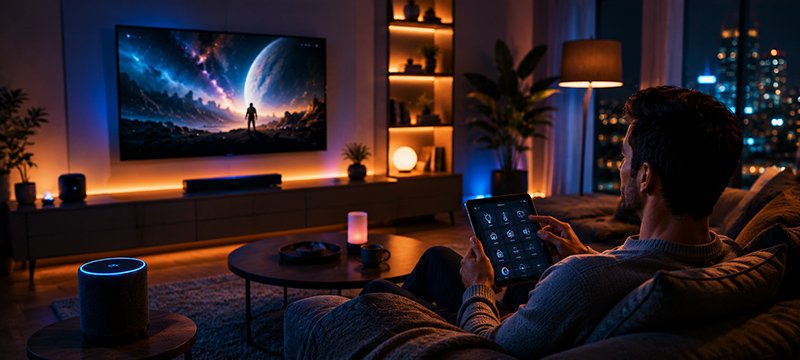
Smart home systems have evolved to create immersive experiences. A single command can adjust lighting, lower blinds, set a comfortable temperature, activate surround sound, start a movie, and even order food.
This innovation redefines what entertainment means in the home. Where traditional setups focused solely on superior picture and sound quality, smart homes facilitate an atmospheric experience. They transform living spaces into private theaters, gaming arenas, fitness studios, or music lounges depending on the occasion.
Shifting Consumption Patterns
The paradigm of “watching TV” has shifted dramatically. Living rooms now serve as platforms for multifaceted experiences. A typical evening may blend a movie on the main screen, football scores on a smartphone, a PlayStation session, and an ongoing group chat.
This shift explains why the digital entertainment market continues to expand across various categories. For instance, the online gambling sector is projected by Mordor Intelligence to grow from $121.93 billion in 2026 to $211.99 billion by 2031, driven by smartphone use, the rollout of 5G technology, and increasingly harmonized regulations across major markets.
The key takeaway is not that every household uses every available service, but that homes are flexible enough to accommodate a variety of entertainment options. Cinema, gaming, music, sports, social interaction, fitness, gambling, and shopping now coexist within the same connected domestic ecosystem.
Implications for IoT Businesses
According to Fortune Business Insights, smart entertainment devices are set to constitute approximately 28.78% of the smart home market by 2026, with North America accounting for 31.70% of the global smart home market in 2025. This presents compelling business opportunities for IoT companies. The effectiveness of smart TVs, speakers, lighting systems, thermostats, routers, sensors, and apps will increasingly hinge on the cohesive experience they provide rather than their standalone performance.
A speaker’s value increases when it follows the user throughout the home, while a TV becomes indispensable as a gateway for streaming, gaming, music, commerce, and overall home control. The smart home is evolving beyond mere task management; it is about creating engaging environments. The future of home automation will entail not just switching on lights but also inquiring about the type of evening the occupants desire.